Sibling Discount
Beta feature. Part of the Loyalty Program.
Pay-as-you-go programmes: The sibling discount is designed for subscription, instalment, and one-off payment plans. It is not recommended for Pay-as-you-go (pay per session) programmes — the discount counting logic may not behave as expected. If you run Pay-as-you-go programmes and want to use a sibling discount, contact us and tell us how you'd like it to work.
The sibling discount automatically rewards families who register more than one child. When the same parent registers a second, third, or fourth child, Zooza applies the discount at booking — no manual codes needed.
Why offer a sibling discount?
Families with multiple children are a high-value segment. When parents weigh the cost of registering siblings, the total price can become a barrier. A sibling discount:
- Removes the hesitation — a visible discount makes the decision easier for parents.
- Increases retention across siblings — once a family commits to multiple bookings, they are less likely to drop out.
- Sets you apart — not every provider offers automatic family pricing.
A typical setup: 10% off for the 2nd child, 15% for the 3rd child, 20% for the 4th child or more. You configure the tiers to match your pricing strategy.

How it works
When a parent completes a booking, Zooza counts how many qualifying registrations already exist under the same email address. The current booking counts as the Nth child.
Qualifying registrations means bookings with Registered status. Waitlist and trial bookings are not counted.
The system then finds the discount rule with the highest child threshold that is still ≤ N, and applies that discount.
Example: Rules set to 2nd child: 10%, 4th child: 20%. Parent registers their 3rd child → the 2nd-child rule applies (10%), because 3rd child is ≥ 2 but < 4.
The count is taken once, at booking
Deleting a registration does not recalculate the discount on the others. Nothing re-runs; the discount that was applied stays applied.
This surfaces on parent-and-child programmes, where a family sometimes creates two separate bookings — one for the adult, one for the child — and the second is counted as a sibling. Delete the surplus booking and the discount on the survivor is still there, usually showing as an overpayment.
Put it right on the booking itself: open the instalment and correct the amount. See Session payment adjustments.
Set up the sibling discount
Go to Sales & Payments → Loyalty Programme → Sibling Discount.
Step 1: Choose how children are counted
The counting scope determines what registrations count toward the child number.
| Scope | What it counts |
|---|---|
| Per billing period (default) | Registrations within the same billing period across all programmes. |
| Per course | Registrations in the same programme only. Both children must be registered in the same programme. |
| Across all classes | All registrations regardless of programme or period. |
When you select Per course, a course picker appears so you can choose which programmes participate.

Step 2: Add discount rules (tiers)
Each rule defines the discount for a specific child threshold. You can add up to four rules — one for each of: 2nd, 3rd, 4th, and 5th child.
Click + Add Rule. A rule form opens with the first available child number pre-selected.
For each rule, set:
- Name — an optional label for this rule (e.g. "2nd child discount"). Useful when you have multiple rules and want to identify them at a glance.
- From child — which child number this tier starts at (2nd, 3rd, 4th, or 5th)
- Discount type — percentage or fixed amount
- Discount value — the amount to deduct
Click Save Rule. Repeat for each tier.

Tips:
- You do not need to define a rule for every child number. A single rule for the 2nd child applies to all subsequent children unless you add a higher tier.
- Rules with a lower child number automatically cover all children above them if no higher rule exists.
- Each child number can only be used once across all rules.
Step 3: Enable the discount
Once you have at least one rule, the Enabled toggle becomes active. Check it and click Save Settings.
The sibling discount is now live. Zooza applies it automatically at the next qualifying booking.
Discount rules in detail
Which programmes are eligible?
By default (counting scope: Per billing period or Across all classes), the discount is evaluated across all your programmes. No additional programme filtering is needed.
When Per course scope is selected, you choose specific programmes via the course picker. Only bookings in those programmes count toward the child number, and only those programmes receive the discount.
Tier evaluation logic
Rules are evaluated by child threshold from highest to lowest. The highest rule that still applies wins.
| Rules | Booking scenario | Applied discount |
|---|---|---|
| 2nd child: 10% | Registering 2nd child | 10% |
| 2nd child: 10%, 4th child: 20% | Registering 3rd child | 10% (2nd-child rule is the highest applicable) |
| 2nd child: 10%, 4th child: 20% | Registering 4th child | 20% |
| 2nd child: 10%, 4th child: 20% | Registering 1st child | No discount |
Fixed amount vs percentage
Both discount types are supported. Fixed amount discounts are displayed with your currency (e.g., €10.00) in the rules list.
When stacking discounts across models (see Loyalty Program — combination mode), each discount is calculated from the original price before any other loyalty discount is applied.
How discounts apply to payment plans
| Payment plan type | How the sibling discount is applied |
|---|---|
| One-off | Deducted from the total in a single discount row. |
| Instalments | Distributed proportionally across all scheduled payments. |
| Membership | Applied on every billing cycle renewal for as long as the membership is active. |
| Pay per session | Applied individually to each session. |
Applying discounts to manual registrations
The sibling discount is applied automatically only when a client books through the booking widget. When you create a registration manually from the admin panel, the loyalty discount is not applied automatically.
If you want to apply a family discount to a manually created registration, you have two options:
Option 1 — Payment plan with a built-in discount
Assign a payment plan that includes a percentage discount (configured in Programmes → Settings → Price and payment → Payment plans). This is the cleanest way to apply a consistent discount to a specific registration.
Option 2 — Discount code
Create a one-time discount code and apply it to the booking. Discount codes work independently of the loyalty program and are a valid way to apply a sibling discount manually when needed. See Discount code.
Both options are complementary to the loyalty program — they do not replace it and do not interfere with automatic discount evaluation on online bookings.
Zooza recognises the same child under a different spelling
Until late October 2026 the discount was matched on an exact name, and two ways of cheating it — or of tripping over it by accident — were common:
- A parent books a child, does not pay, and instead of paying from their profile goes through the booking form again. The second booking got a sibling discount, because Zooza thought a second child was being booked.
- A parent books the same child into a second class and gets a sibling discount for them.
Both are now caught. Zooza compares the incoming child against the children it already has for that parent, tolerantly:
- Spelling, spacing, capitals and diacritics are ignored. Maťko and matko are one child; so are Kovács and Kovacs.
- First and last name swapped counts as the same child — Maria Popescu and Popescu Maria.
- Nicknames and diminutives are understood, when the date of birth agrees: Hana / Hanka, Michal / Miško, Samuel / Samko, Stela / Stelka, Adam / Adamko.
- Typos are forgiven within a couple of letters, when both names are reasonably long, start with the same two letters, and the date of birth agrees — Krisina / Kristina.
- Compound first names match their parts: Patrick and Patrick-Andrei.
And two siblings are never mistaken for one child. A male/female pair that differs only by the ending — Martin / Martina, Michal / Michaela, Šimon / Šimona, Dominik / Dominika — is always treated as two children. These are real siblings and they keep their discount.
Why the date of birth only ever confirms a match and never decides one. Checked against live data: thousands of pairs with identical names carry different dates of birth (mistyped years, day and month swapped), and thousands more share a date of birth with completely unrelated names — far more than twins explain. So a matching birthday supports a loose name match, and a mismatched one is not treated as proof of a second child.
Unpaid earlier bookings no longer count toward the child number, for the sibling discount and for the returning-customer discount. That is what closes the re-booking route specifically.
What is still not caught
The same child typed twice in one submission. If a parent fills the form with two people who are really the same child and submits once, the discount still applies. The matching compares the incoming child against earlier bookings, not against the other rows of the same form.
Discounts already granted are not corrected. Nothing is recalculated retroactively, so anything given away before this shipped stays given away.
So the advice from before still holds, in a smaller way: keep a clause in your terms allowing you to withdraw a discount granted in error, and glance at single-child bookings carrying a sibling discount in the first weeks after you switch it on.
Ask us when a discount surprises you. Every matching decision is now recorded — which signal matched and why — so support can tell you exactly why a particular family did or did not get the discount, rather than guessing.
Restrict the discount to logged-in clients
There is now a Only for logged-in clients switch on the sibling discount and on the returning-customer discount, in Loyalty Programme → Sibling Discount.
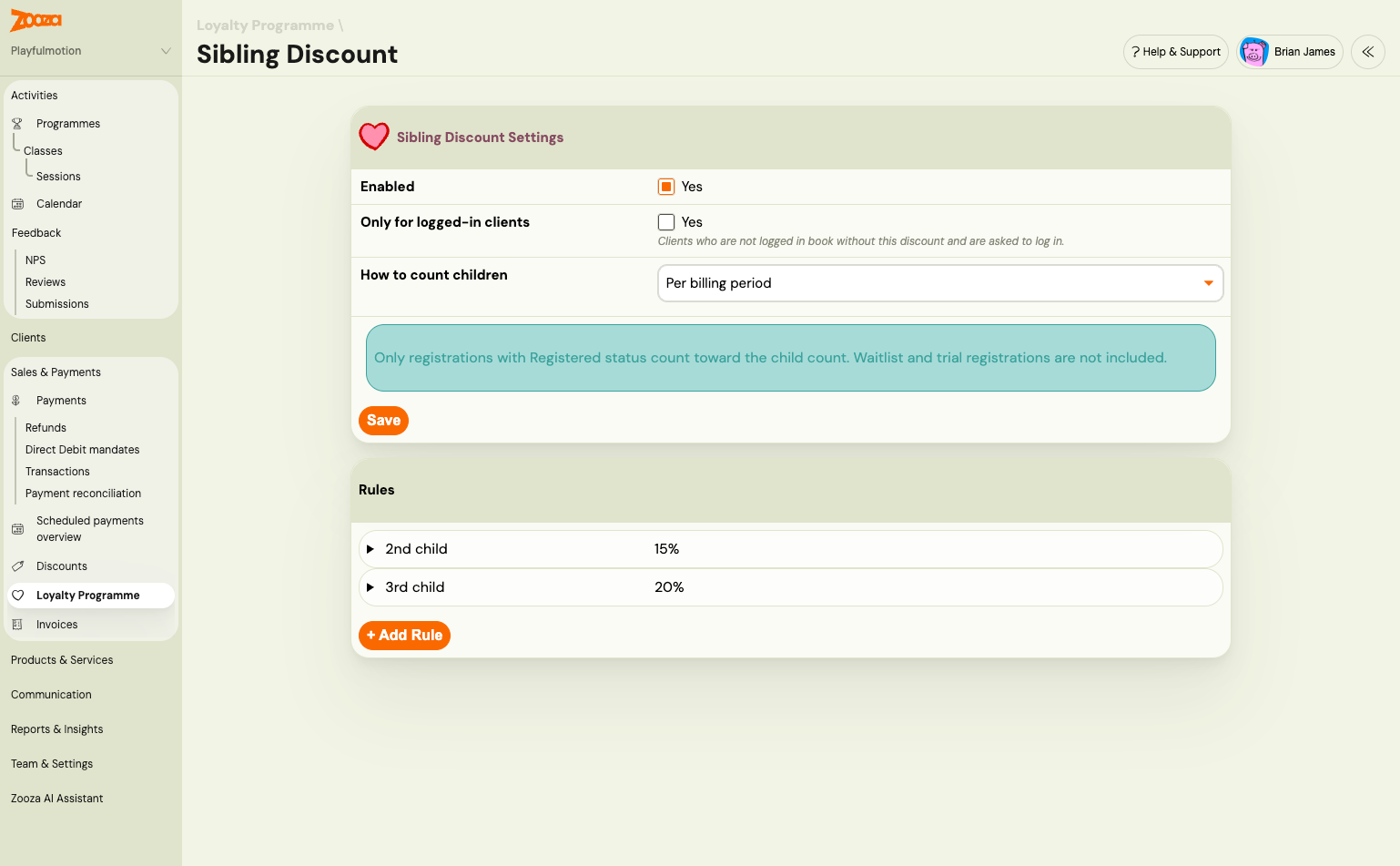
With it on, a client who is not logged in books at full price and is asked to log in; the booking page tells them there is a discount waiting if they do. A logged-in client's children are records Zooza already has, so the matching above has the best possible information to work with.
The trade-off is real. Parents arriving from a direct booking link do not log in first, so you will lose discounts you meant to give, and some will simply pay more without noticing why. Worth it where the discount is large; usually not worth it where it is a token.
Not available on the referral discount. Referral exists to bring in people who do not have an account yet, so requiring a login would defeat it.
Disable or delete the sibling discount
To disable without losing your rules: uncheck Enabled and click Save Settings. The rules are preserved and you can re-enable later.
To delete a rule: open the rule by clicking its summary row, then click Delete in the rule form. If you delete the last rule, the model is automatically disabled.
Frequently asked questions
Does the 1st child ever get a discount? No. The sibling discount starts from the 2nd child. The first child always pays the full price.
What if a parent registers 5 children but I only have a rule for 2nd and 3rd child? The 3rd-child rule applies to all children from the 3rd onward (4th, 5th, etc.) unless you add a higher tier.
Does the discount apply if one child is on the waitlist? No. Waitlist and trial registrations do not count toward the child number.
Can siblings be in different programmes? Yes, when counting scope is Per billing period or Across all courses. When scope is Per course, both children must be in the selected programme(s) for the count to apply.
Can I offer a sibling discount on only some programmes? Use the Per course scope and select the programmes you want to include.
What happens if I change my rules after existing bookings? Existing bookings are not affected. The new rules apply only to bookings made after the change.
For more, see Loyalty Program FAQ.