Inbound payments — setup and pairing
Inbound payments is the system that watches your bank account for incoming transfers and automatically matches each payment to the correct booking or order. When a client pays by bank transfer, Zooza picks it up, identifies which registration it belongs to, and records it — without manual entry.
How it works
- Your client pays to your bank account using the reference number (variable symbol) from their invoice or payment schedule.
- The bank notifies Zooza (via GoCardless, email notification, or CSV import).
- Zooza parses the transaction and looks for a matching booking using the reference number.
- If a match is found and there are no issues, the payment is paired automatically and appears on the registration.
- If something is unclear, the payment lands in Manual review for you to handle.
Setting up ingestion
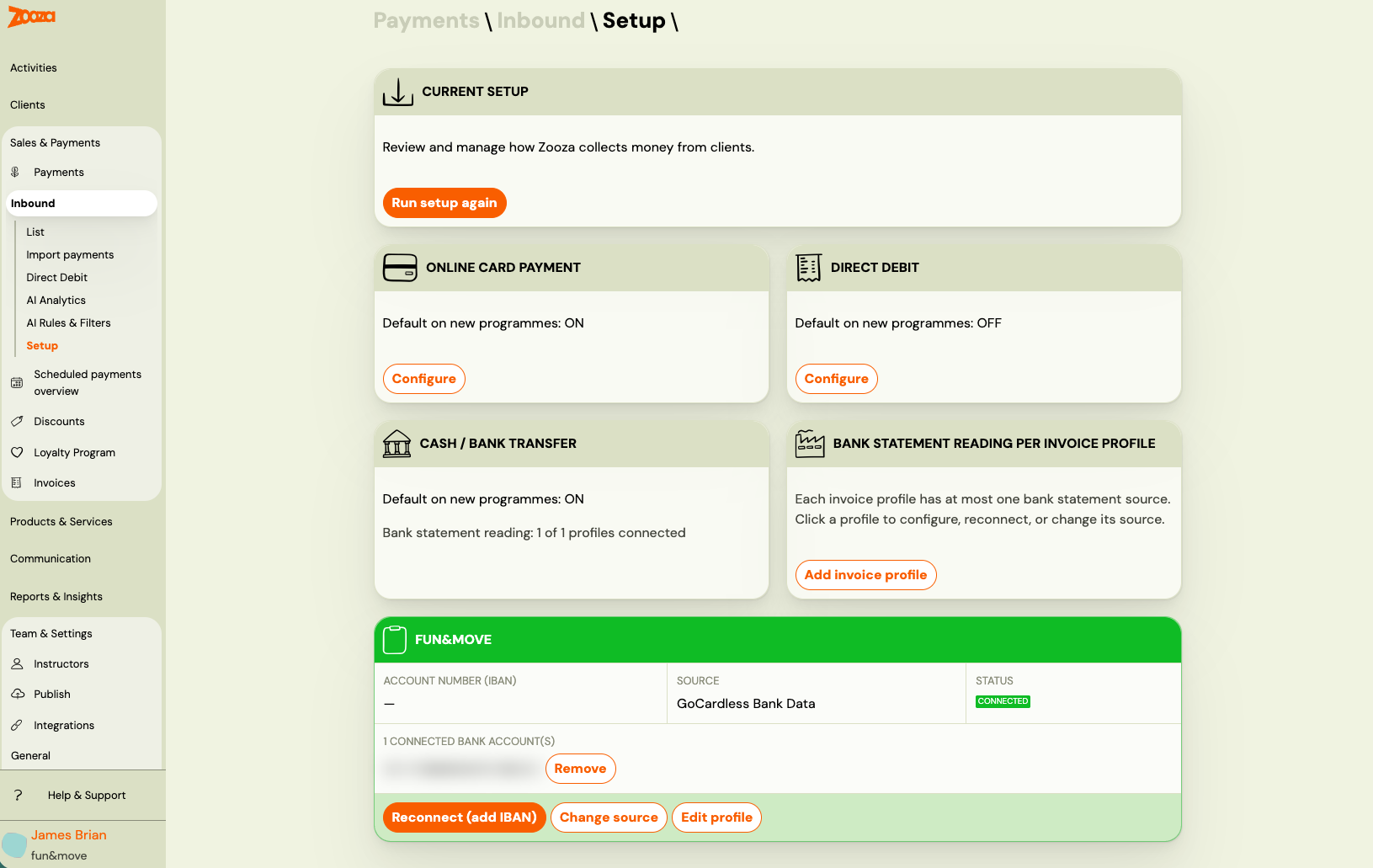
All payment channel setup is done through the Setup wizard at Settings → Billing & Payments → Payment collection setup. The wizard walks you through each channel — online card, direct debit, and cash / bank transfer — and lets you configure bank statement reading per billing profile.
Before Zooza can receive bank transfers, you must connect at least one ingestion channel.
Which method should I use?
The Setup screen offers each bank account two ways to read incoming payments. Pick one per account.
| Bank email parser | GoCardless bank data | |
|---|---|---|
| How it reads | Your bank emails Zooza on every transaction | Open banking connection to the account |
| Speed | Payments appear in seconds | Refreshes on a schedule |
| Coverage | Only banks Zooza has built a parser for | 2,500+ European banks |
| IBANs per profile | One | Several |
| Upkeep | None once your bank is sending | Consent must be renewed every 90 days |
Choose the email parser if Zooza supports your bank. It is faster and nothing expires.
Choose GoCardless if your bank has no parser, if its notification emails are unreliable, or if one billing profile needs more than one IBAN.
The account's current state is shown at the top of the screen. Source tells you which method is active — Not collecting bank transfers means neither is set up — and Status shows whether data is arriving (NO STATEMENT FEED versus RECEIVING BY EMAIL).
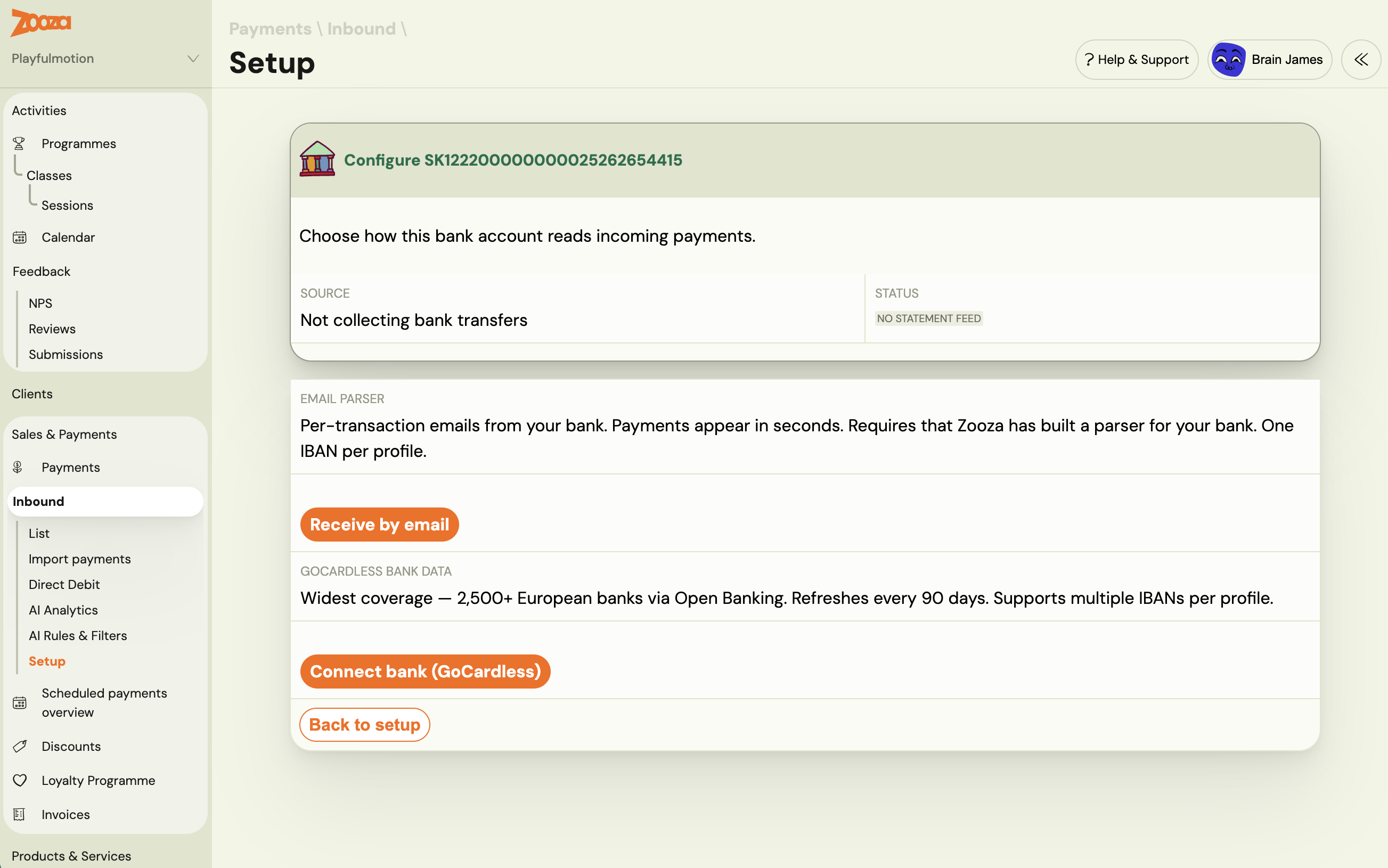
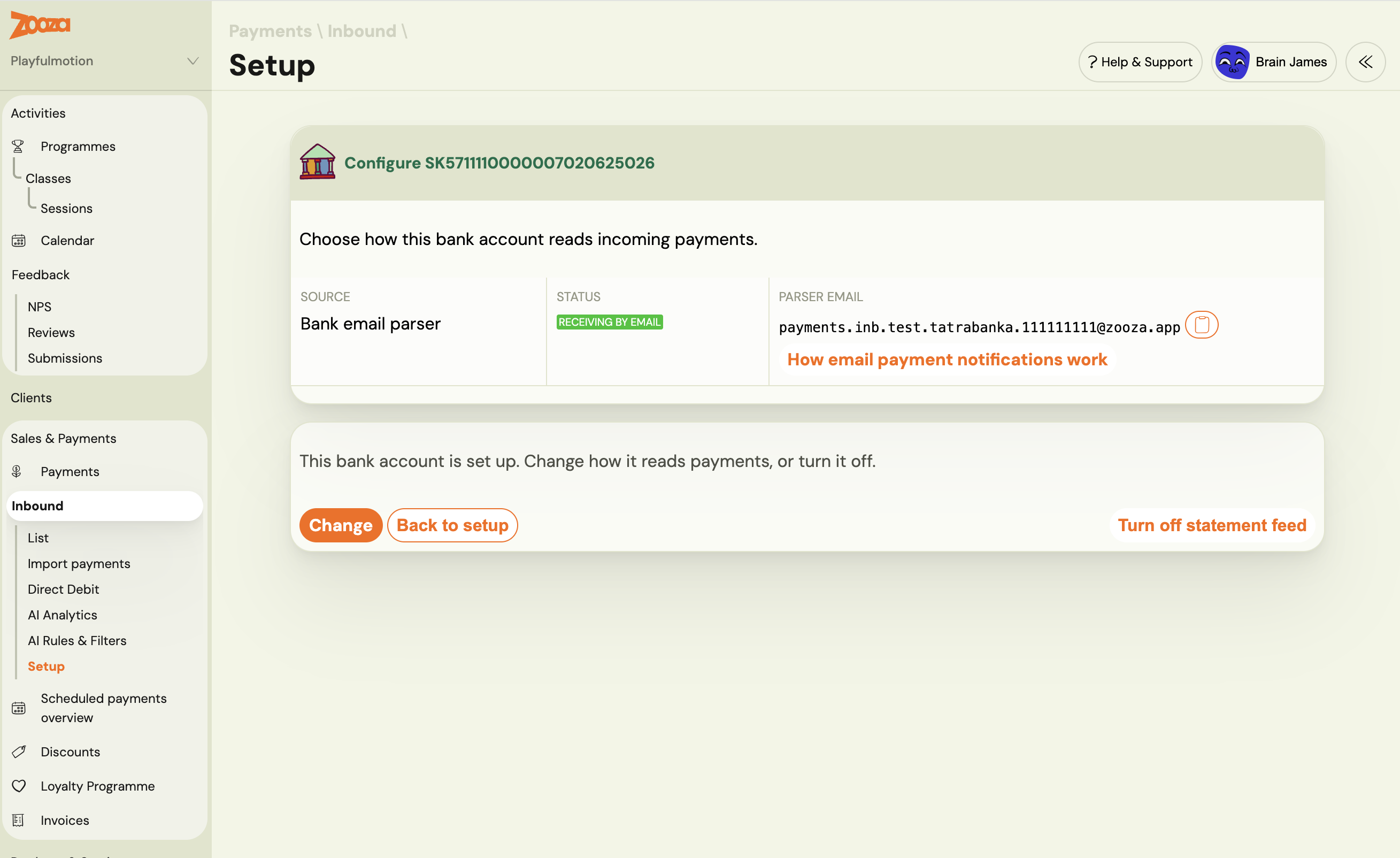
Setting this up is two separate jobs. The bank account itself is configured on the billing profile; how it is read is configured here. If payments are not arriving, check that both are done — one without the other does nothing.
GoCardless (open banking)
GoCardless here acts as a bank account reader, not a payment processor. It monitors your bank account for incoming transactions and reports them to Zooza in real time.
This is separate from GoCardless as a direct debit gateway. GoCardless has two roles in Zooza — collecting direct debits from clients, and reading your bank account for incoming transfers. These are independent features.
To connect:
- Go to Settings → Billing & Payments → Payment collection setup.
- In the Current setup screen, find your billing profile and click Reconnect (add IBAN) or configure it from the Cash / bank transfer step of the wizard.
- Select your bank and authorise GoCardless to read your transaction data (standard open banking consent flow).
- Once connected, incoming transactions are detected and processed automatically.
Important — consent expiry: Your open banking consent expires periodically (varies by bank, typically 90 days under PSD2). When it expires, transaction notifications stop. Zooza does not send an alert when the consent expires — you will notice the absence of incoming payments in the dashboard. Reconnect promptly via Settings → Billing & Payments → Payment collection setup.
Bank email notifications
Most banks can send you an email when a payment arrives. Zooza generates a unique email address for each of your billing profiles. You set your bank to forward payment notifications to that address.
To find your inbound email address:
- Go to Settings → Billing & Payments → Payment collection setup.
- Open the Cash / bank transfer step.
- Select your billing profile and choose Email parser.
- Copy the generated email address and configure your bank to forward payment notifications to it.
Supported banks:
| Country | Banks |
|---|---|
| Slovakia | Tatra Banka, VÚB, SLSP (Slovenská sporiteľňa), UniCredit, Prima Banka, FIO, ČSOB |
| Czech Republic | ČSOB, Raiffeisenbank, FIO, Komerční banka |
Each bank uses a different email format — Zooza has a specific parser for each.
CSV import
For manual or one-off import of bank statement data:
- Go to Payments → Transactions → Import payments.
- Upload a CSV file with the required columns:
posting_date,amount,currency(required), plus optionalpayers_iban,variable_symbol,information_for_beneficiary. - Each row is processed individually. Duplicates are detected and skipped automatically.
Maximum 100 rows per import.
How payments are matched
Zooza uses the variable symbol (reference number) from the transaction as the primary matching mechanism. This is the number printed on the client's invoice and in their payment instructions — it matches the registration or order ID in Zooza.
Matching order:
- Variable symbol → registration — direct lookup by order number.
- Variable symbol → product order — if no registration found.
- Custom customer ID — if the client used their own customer ID as the reference number.
After a match is found, Zooza runs validation checks: the booking must be active, the payment status must allow new payments, and the schedule must not be expired.
Delegation chains: Some registrations delegate payment management to another registration (e.g. a parent registration managing siblings). Zooza follows these chains automatically and pairs to the correct managing registration.
Finally, an AI layer checks for duplicates — it confirms the match or flags anything suspicious for manual review.
Payment statuses
| Status | Meaning |
|---|---|
| New (manual review) | Zooza could not match the payment automatically. You need to pair it or ignore it manually. |
| Paired | Payment was matched to a registration and recorded in the payments ledger. |
| Ignored | Payment was identified as not relevant (rent, utilities, etc.) and will not be processed. |
There is no "pending" state visible to admins — a payment is either waiting for you (New) or already handled (Paired/Ignored).
Manual review — what to do
Payments that land unpaired need your attention. Go to Payments → Payment reconciliation and filter the queue to Unpaired.
Pairing manually
- Click the payment.
- Select the registration or order it belongs to.
- Confirm.
The payment is recorded on the booking and the payment status updates immediately.
Ignoring a payment
If the payment is not related to Zooza (rent, utilities, salary, etc.):
- Click the payment.
- Click Ignore.
- Optionally, choose Create filter — Zooza will set up an automatic rule to ignore similar payments in the future (based on the payer's IBAN and payment note).
Monitoring for payments that need your attention
Payments in New status do not send you a notification — you need to check the queue yourself. Zooza does not email or alert you when an unmatched payment arrives.
Recommended workflow: Check Payments → Payment reconciliation once per day, filtered to Unpaired. On a typical day that view should be empty — everything matches automatically. When something appears, it means a payment arrived that Zooza could not pair on its own.
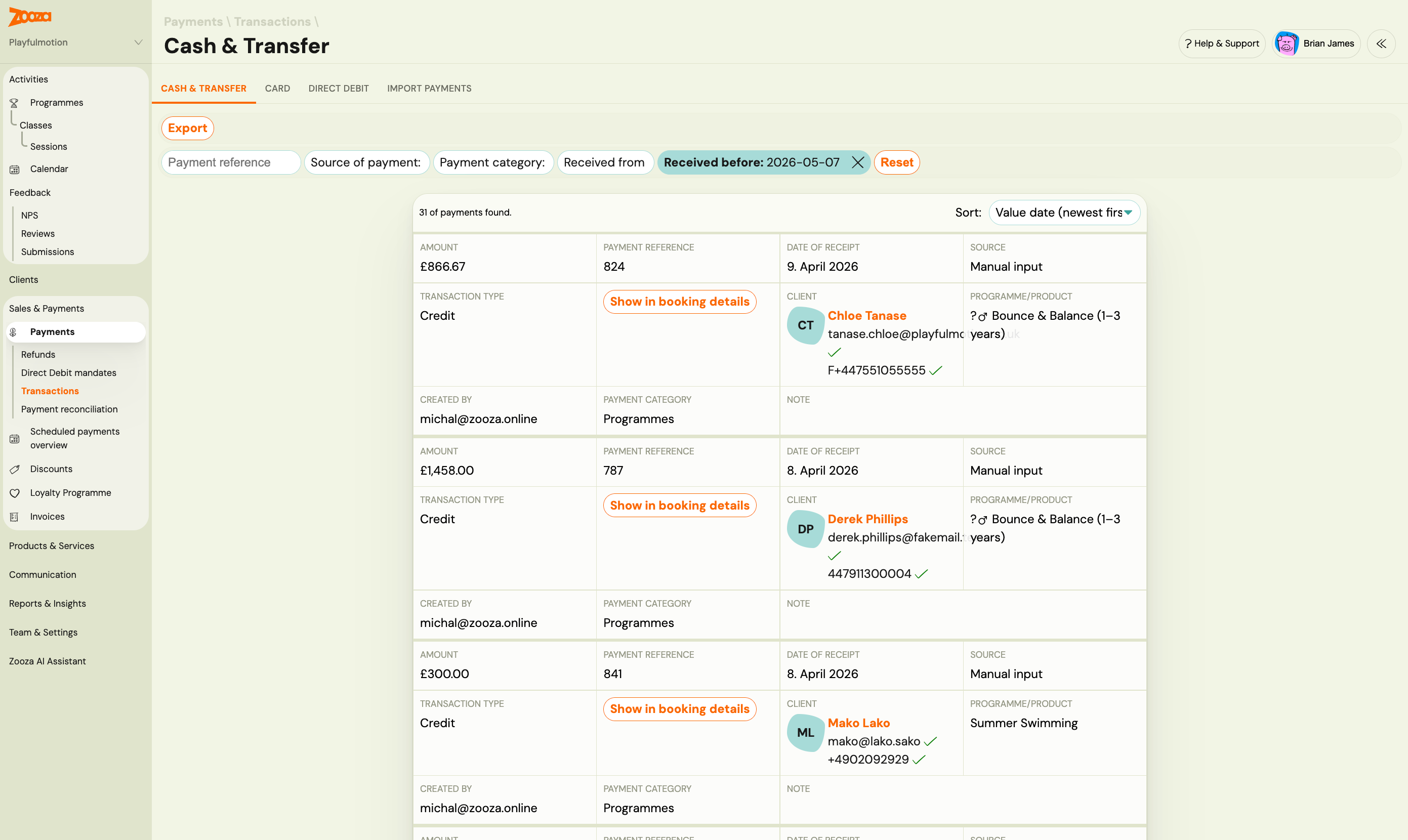
Two lists, two jobs. Payment reconciliation is the queue of bank rows waiting to be matched — that is where unpaired money sits. Transactions is the settled ledger of money already recorded, split into Cash & Transfer, Card and Direct Debit tabs, each with its own export. Money moves from the first to the second once it is paired.
The count badge on the Inbound menu item shows the number of outstanding New payments. If you see a number there, there are payments waiting for your action.
Tip: If you regularly see the same payer in manual review (e.g. a corporate account paying by bank transfer without a reference number), write a Business rule or Pairing rule under Payments → Payment reconciliation → AI rules & filters so Zooza knows how to handle it automatically next time.
Ignore filters
Filters let you automatically ignore recurring non-Zooza payments. When a filter matches an incoming payment, it is ignored immediately without any manual action.
A filter matches when:
- The payer's IBAN matches exactly, AND
- The note pattern matches (if configured).
Filters have built-in safeguards — a filter cannot be so broad that it starts catching real Zooza payments. If you manually override 3 ignored payments from the same filter (by pairing them instead), the filter is automatically deactivated.
You can manage filters in Payments → Payment reconciliation → AI rules & filters.
Business rules
Business rules are natural language instructions you write to guide how payments are evaluated. They are included in the AI's context when it reviews incoming payments.
Example rules:
- "Payments from IBAN SK12... arriving within 3 days of each other with the same amount are duplicates."
- "When the reference number starts with 9, it belongs to a product order, not a course registration."
Rule types:
| Type | Purpose |
|---|---|
| Dedup | When to consider two payments duplicates |
| Ignore | When to ignore a payment regardless of match |
| Pairing | Special logic for matching payments to orders |
To add rules: Payments → Payment reconciliation → AI rules & filters. Maximum 10 active rules per account.
A payment is nowhere in Zooza at all
Before hunting through filters: for a bank payment to appear in Zooza in the first place, three things all have to be true.
- Zooza can tell which account the notification belongs to — that is what the address you set in your internet banking is for.
- Zooza can read the body of the email. If the bank changes its template, this is the step that breaks. It is what happened with Fio in August 2026.
- It is not a duplicate. A payment already recorded is not recorded twice.
Clear all three and the payment shows up — either paired, or waiting in the queue. And if you have ignore rules set, an ignored payment is still there: filter the reconciliation queue to Ignored and you will find it.
If a payment is genuinely missing, send the bank statement. With the statement line we can trace where it stopped. Every notification email is kept, so even a payment that never surfaced can usually be found after the fact.
Troubleshooting
Payment is in manual review (New) — why wasn't it auto-paired?
To find the exact reason for a specific payment, open the row from Payments → Payment reconciliation and look for the Matching Process Summary section. It shows which step the matching stopped at and why.
Common reasons:
- The client used a different reference number (not the variable symbol from the invoice).
- The booking was cancelled or deleted by the time the payment arrived.
- The payment schedule ended more than 3 months ago.
- The payment amount is larger than the remaining balance (flagged as suspicious).
- GoCardless consent has expired — no new transactions are being received.
- AI confidence too low — the match looked probable but not certain enough for automatic pairing. The payment is left for manual review even though the customer and amount appear correct. Open the payment and pair it manually.
Payments stopped arriving — GoCardless connection issue?
Go to Settings → Billing & Payments → Payment collection setup and check the current setup screen. If a billing profile shows a reconnection warning (yellow or red status), click Reconnect (add IBAN) and go through the GoCardless authorisation flow again.
Duplicate payment appeared — how to handle it?
Ignore the duplicate. If you have a filter set up for the payer's IBAN, the duplicate would have been caught automatically. If not, manually ignoring it and creating a filter prevents future occurrences.
Related
- Set up how Zooza collects money from clients — step-by-step wizard for configuring channels and bank statement reading
- Inbound payments — technical reference — full algorithm details, AI evaluation, delegation chains
- Billing and invoicing — billing profiles and IBAN setup
- GoCardless direct debit — collecting payments from clients (separate from bank account reading)
- Payments and Billing FAQ